
END OF YEAR MESSAGE
FROM ICOS PRESIDENT
EDWARD CARR
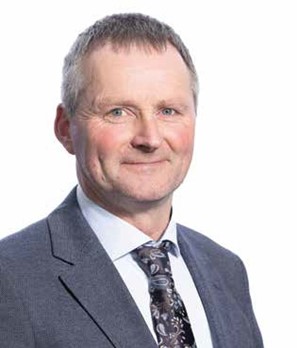
As we come to the end of the UN International year of the co-operative, it is worth reflecting on what has been another busy year for ICOS and the co-operative movement in Ireland. Our core focus is on the co-ops, their rules and governance and their structures. Our associated businesses have a combined turnover in the region of €16 billion, with 175,000 individual members, employing 12,000 people in Ireland, and a further 24,000 people overseas. In total, there are 1,000 co-ops in Ireland, and the largest 100 organisations employ approximately 40,000 people.
These figures alone highlight the valuable contribution which co-operatives continue to contribute to the rural economy. But there are many challenges, from EU legislation, a generational renewal crisis across Europe, volatile weather conditions and fluctuations in global markets combined with geopolitical and trade tensions.
WATER QUALITY
Over the last 12 months, one of our primary objectives has been to continue to improve water quality. We recognise the urgent need to improve trends in water quality. Targeted and coordinated measures spearheaded by the farming sector and government agencies including Teagasc and LAWPRO are beginning to show progress is being made. This is important to point out as farmers and their co-ops are fully committed to improving water quality and doing the right thing for the environment.
I firmly believe that the engagement and work being done by farmers and their co-ops on water quality will deliver the improvement we all want to see. The issue of water quality is front and centre for the farming sector, with the co-ops actively raising awareness of water quality issues through multiple farmer events, targeted support through co-op sustainability programmes, the Farming for Water EIP and the development of co-ordinated catchment level approaches such as the Blackwater, Suir and Slaney Catchment Programmes.
In July, I led a delegation of co-op chairpersons to Brussels to meet key stakeholders where we highlighted this depth of work and where we also raised our concerns about several issues including the future of Ireland’s Nitrates Derogation and the need for a fully funded CAP. We held meetings with Ireland’s EU Commissioner, Michael McGrath, Irish MEPs and senior officials from the EU Council and Commission. And in November, I met with the EU Commissioner for the Environment Jessica Roswall on her visit to Ireland where I outlined to her all the measures our members and farmer suppliers are taking to improve water quality.
All of this helped culminate in the decision on December 8th by the EU Commission to grant Ireland an extension of Ireland’s derogation under the Nitrates Directive. The extension is vital for both generational renewal and Ireland’s family farm model. The derogation isn’t a licence to breach rules, it’s actually quite the opposite in fact with additional compliance and requirements. While I welcome today’s outcome, ICOS is deeply concerned as to how compliance with the Habitats Directive will be implemented as part of our Nitrates Derogation.
CBAM
Another pressing issue for Co-ops relates to the proposed Cross Border Adjustment Mechanism (CBAM) on imports of nitrogen and phosphorus fertiliser from outside of the EEA from January 1st, 2026. Ireland’s fertiliser market is particularly exposed to the impact of CBAM due to our reliance on imported nitrogen and phosphorus from outside of the EEA. Its implementation would result in a knock-on price impact for farmers. I have met with Minister for Agriculture Martin Heydon making the point that this proposal is essentially a tax on food production that must be prevented. At our meeting, the Minister strongly indicated his support for the removal of fertiliser from the CBAM tax from the 1st of January next year. However, we need to see a clear plan of engagement with the European Commission on this matter. ICOS continues to engage at EU level with officials and is working closely with other co-operative and farmer organisations to seek a postponement of CBAM.
CAP CUTS
This coupled with proposed cuts to the CAP budget along with the implementation of mandatory contracts because of a recent vote in the European Parliament, has the potential to create uncertainty for our co-ops at a time when we are struggling to attract young farmers into the sector.
Despite these challenges, the sector continues to demonstrate resilience and innovation. The agri-food sector remains Ireland’s largest indigenous industry, employing 6.1% of the total workforce. Irish agri-food exports continue to perform strongly with the most recent figures showing total exports valued at €19 billion in 2024.
Dairy sector exports were valued at €6.3 bn in 2024, with over 1.6 million tonnes of product being shipped to 140 countries worldwide. This is achieved with one of the world’s lowest carbon footprints for dairy and beef. Importantly, every €1 of exports of dairy goods, represents a 90 cent spend within the Irish economy. In stark contrast, every €1 exported by multinational companies represents a 10 cent spend within the Irish economy.
I appeared earlier this month before the Joint Oireachtas Committee on Agriculture to implore on politicians how important it is to retain a well-funded, well-structured CAP. The EU Commission proposals to cut funding and remove Pillar 2 would be catastrophic. The fundamental mission of CAP is (and must remain) to guarantee that Europe’s food is affordable, safe, healthy and sustainably produced. In a world beset by geopolitical tensions, supply-chain disruptions and increasingly frequent climate-related shocks, ensuring a stable and secure food supply for European consumers is more important than ever.
ARRATIPP CO-OP
This year also saw Ireland’s newest co-op, Arrabawn Tipperary Co-operative Society, now trading as ArraTipp Co-op being formally established. As Chairperson of the new co-op, I am delighted for our 1,400 farmer suppliers and staff. This merger is a growth opportunity, and a natural coming together and consolidation of two neighbouring co-ops to create a more resilient and dynamic future for its members. I would also like to thank Conor Ryan who retired as CEO after 20 years at the co-op and I want to pay tribute also to Pat Sheahan for his tenure at North Cork Creameries.
Meanwhile further south, Barryroe Co-operative continues to thrive, and this year celebrated its 100th anniversary and I would like to congratulate the management and board of Barryroe on this historic milestone.
BIOENERGY
ICOS continues to explore opportunities and collaborate in the whole bioenergy space. An example of this is a pioneering feasibility study which was launched during the year to explore a new co-operative model for biorefineries that can unlock fresh investment and create strong market opportunities for rural regions. The study is designed to demonstrate how co-operative enterprise can be at the centre of Ireland’s growing bioeconomy.
Led by ICOS in partnership with Climate KIC, Europe’s leading climate innovation agency, the study has received backing from the Government, the European Union, South-East Regional Assembly, Enterprise Ireland and the Golden Jubilee Trust. It has an advisory committee representing a “Who’s Who” of agriculture, climate, energy, research, financial and sustainability interests.
The Collaborative Bio-Industrial Alliance (to be called Comhar BIA) will assess how co-operatives and their members can work together to turn agricultural and food processing by-products into high-value outputs such as renewable energy, natural fertilisers, biomaterials, chemicals and food and feed ingredients.
The project centres around the concept of co-operatives as an initial focal point to identify complementary partners, feedstocks, processes and market outputs so that a regional co-owned biorefinery can be appropriately sized, sited, funded and developed.
SKILLNET
The learning and development division of ICOS continues to partner with Skillnet to bring training modules to our co-operative members. In 2025, we will have completed 15,000 person days of training. Meanwhile we continue to collaborate with University College Cork (UCC) for the Diploma in Corporate Direction (Food Business), the bespoke leadership programme with this year’s intake of 24 young leaders spread across several of our co-operative membership base.
RAISE
A structured new initiative aimed at securing the future of Irish farming was also officially launched this year with our support. The RAISE Project (Renewal of Agriculture through Intergenerational Support & Empowerment) brings a people-focused approach to one of rural Ireland’s most pressing challenges, generational renewal in agriculture.
A steering group of Agri-sector stakeholders has been established (called the Sustainable Agriculture Advisory Council) including ICOS, Teagasc, UCC, Macra Na Feirme, Aurivo, Dairygold, Lakeland Dairies, Tirlán, and three active farmer representatives, in a multi-stakeholder approach.
This aims to address the issue of generational renewal which I referred to earlier. Across Ireland, farmers are ageing and while many young people aspire to work the land, they often find themselves locked out by limited access to land, resources or mentorship. Meanwhile, older farmers face uncertainty about the future of their farms, also burdened by the emotional and financial weight of succession decisions.
The future of farming lies in connection, not just to the land but to one another. RAISE is about bridging the gap between generations and ensuring farming is something that people feel supported to enter and proud to pass on.
MARTS
I want to pay tribute to our mart members. 2025 was another very positive year for livestock marts in Ireland. The dramatic rise in beef and sheep prices since September 2024 continued throughout the year. Beef prices touched almost €8.00 per kilo during the summer and lamb prices of almost €10 per kilo occurred during January and February. Online trading continues to grow as a means of purchasing farmers to source their livestock. And the display of genomic information ensures that purchasing farmers can make informed decisions regarding their bidding decisions from a pricing perspective. But also, increasingly from an animal health point of view more information continues to be provided by mart display boards. Farmers have realised with the increasing prices on offer the benefits of putting all their livestock through the live auction rings as the meat processors continue to purchase significant numbers of cattle and sheep via the marts online trading platforms and pay significantly more to farmers than dealing directly to the meat factories.
CATTLE
ICOS mart throughput increased nationally by 2.1% during 2025 and we are heading for almost 2.0 million cattle being sold through the livestock mart network, an all-time high for the last 25 years.
Farm to farm movements continued their decline in 2025 with 90,000 less cattle being traded in this way. Farmers are again seeing the great benefits of supporting their local livestock mart and the security of payment that the client account cheque, and oversight by the Property services regulatory authority (PSRA) brings, versus private trading.
SHEEP
1.4 million sheep were traded in the livestock mart network during 2025 across the country which is down slightly on the 2024 numbers. Unfortunately, many marts report that even with the relatively good returns from sheep farming, the aged demographic profile of current sheep farmers means a constant number of farmers exiting the business year on year with no immediate successors willing to replace them. Many marts reported increased dispersal and cull ewe sales which doesn’t bode well for the future.
The reduction in national flocks across the EU seems to be continuing even with the increased prices and even the global sheep meat powerhouses of New Zealand and Australia cannot increase production to meet global demand. Traditionally France was the destination for most of our sheep meat exports but with the rise of the Muslim religion the festivals of Ramadan and Eid now have a major influence in the price and has created demand in many other European countries.
I look back on 2025 with cautious positivity. Co-operatives continue to show great resilience and innovation in preparation for choppy waters ahead. As President of ICOS, I will continue to motivate our members to meet the challenges head on, but this can only be done with reasonable compromise from legislators in Ireland and in Brussels. Ireland takes on the Presidency of the EU in July 2026, and we hope that the government will use this opportunity to prioritise the concerns of co-operatives and farmers regarding the many issues I have outlined here.
Finally, as we reach the end of the year, I want to wish all ICOS members a very Happy Christmas and good wishes for the new year.